The story of Val Saint-Lambert Crystal, how it became a symbol of Belgian artistry, and where to celebrate its bicentenary in 2026.
The beginnings of Val Saint-Lambert Crystal
In 1826, two entrepreneurs stood in a ruined Cistercian abbey on the banks of the Meuse in Seraing, Wallonia. The monks were long gone, chased out by the French Revolution. But perhaps they felt something appealing about the space, the silence, the air. Their names were François Kemlin and Auguste Lelièvre.
Whatever inspired them, they founded the limited company Verreries et Établissements du Val Saint-Lambert. They then brought skilled glassworkers from the celebrated Vonêche glassworks in the Ardennes, and eventually struck a match to light the first furnace. Within a few years they were making everything from preserving jars to the finest crystal the region had ever seen.
Two centuries later, this factory and a number of museums around Belgium are gathering to mark two hundred years of craft, ambition and beauty – as well as more than a little heartbreak – of Val Saint-Lambert Crystal.
Sand, lead, and a secret formula
Ask a glass-blower what separates crystal from ordinary glass and the answer is immediate: “Crystal reflects light; glass absorbs it.” The secret is lead. By adding lead oxide to the molten mix, the material becomes denser, softer to work, and astonishingly clear.
Val Saint-Lambert’s traditional formula is 61 percent sand, 24 percent lead, 9 percent soda, 4 percent potassium, and the rest a closely guarded secret. This combination gave their pieces a weight and a brilliance that set them apart. Clink two genuine crystal glasses together and you’ll hear that difference with that sharp, resonant “ping”.
I suppose you could say that crystal is the combination of the four elements: earth, fire, water, and the breath of the crystal blower. Every piece is shaped by hand, cooled slowly in a resting oven, then ground and polished by eye.
Val Saint-Lambert Crystal on the world stage
A key to the growth of Val Saint-Lambert Crystal was early Royal patronage. After Belgian independence in 1830, King Leopold I became a shareholder. Crystal from Seraing became a diplomatic gift. It was something that Belgian monarchs and ministers presented on foreign visits as a statement of national pride. By the time the Société Générale took over in 1836, the factory was in a healthy position.
The Golden Age: 5,000 workers in a small town
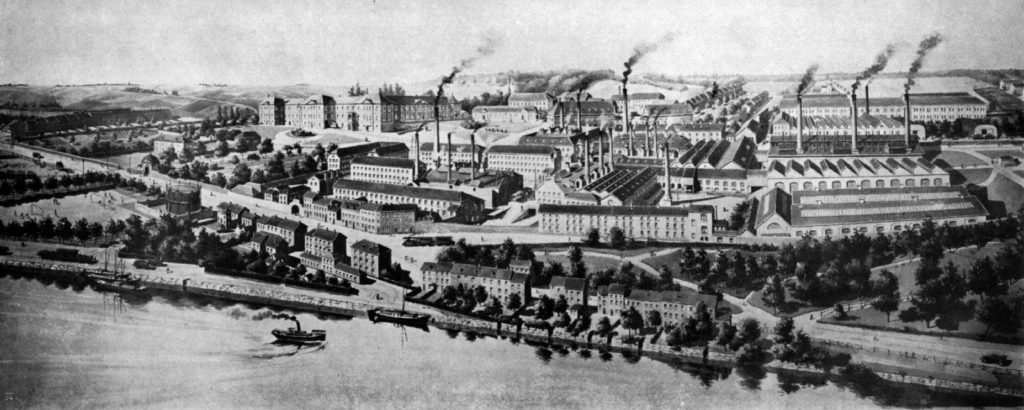
Between 1880 and 1914, Val Saint-Lambert was more than a factory; it was a small town. At its peak, around 5,000 people worked within its walls. Production ran to 125,000 pieces a day.
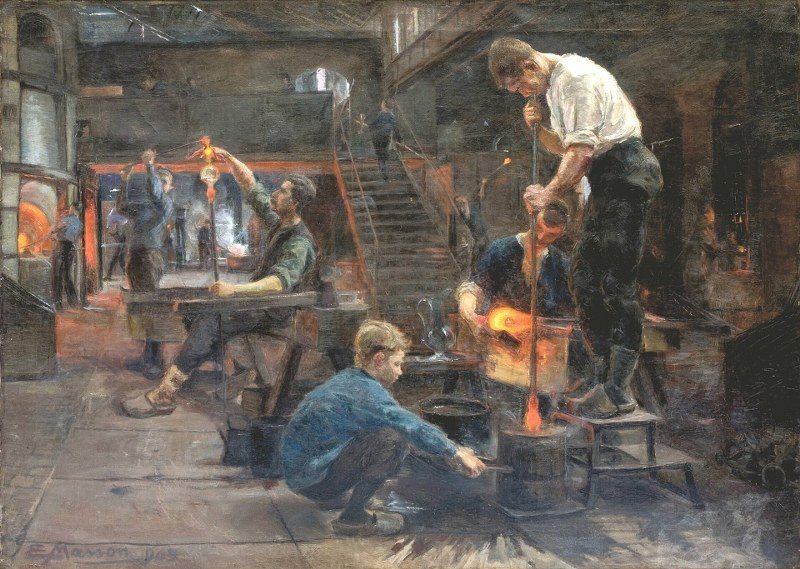
The site had its own schools, cinemas, theatres, music associations, a general store, a church, medical facilities, and a mutual insurance fund. It was, as one long-serving manager puts it, “the perfect illustration of the paternalistic side of the industrial revolution, but everyone could benefit from it.”
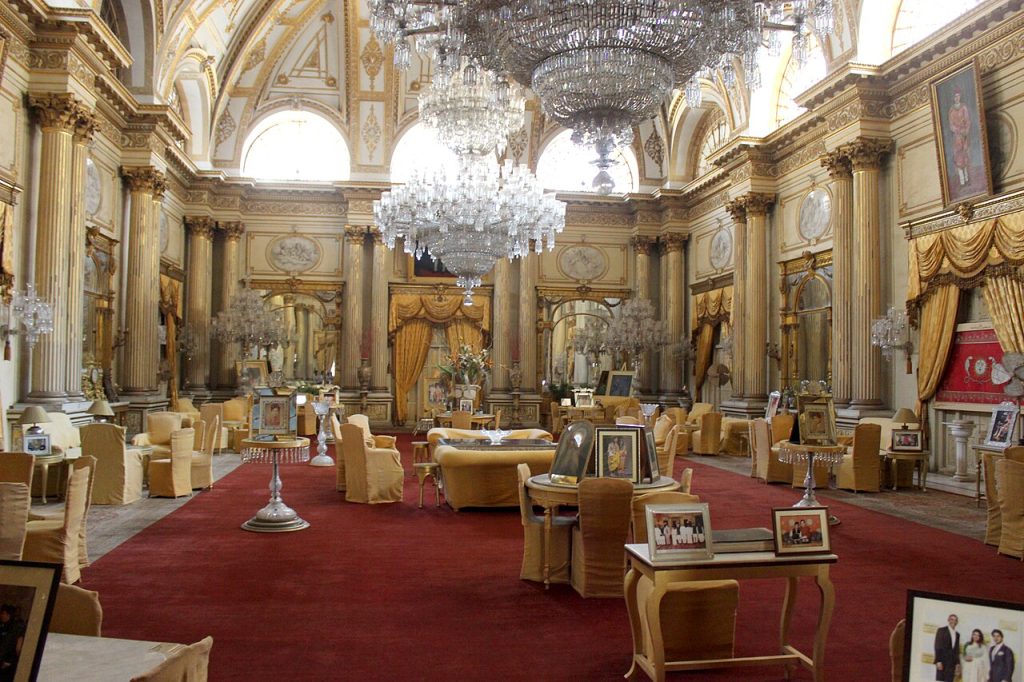
Nearly three-quarters of production was exported. Russian tsars ordered in bulk. Indian maharajas commissioned two monumental crystal chandeliers for the palace of the Maharaja of Gwalior. Each weighed 3.5 tonnes and stood 13 metres high (the largest in the world at the time). Legend has it that the architect had elephants walk across the palace’s first floor before the chandeliers were hung, to test whether the ceiling could bear the weight. (Thankfully for the elephants, the ceiling held!).
In 1894, Val Saint-Lambert arrived at the World’s Fair in Antwerp with something extraordinary: the Vase of the Nine Provinces. It stood 2.25 metres tall, weighed 200 kilograms, and was assembled from 82 individual crystal components. Thirty artisans had worked 2,000 hours to create it. The crowds were astonished. The piece became legendary. Today it still stands in the Grand Curtius Museum in Liège, classified as a regional treasure.

Art Nouveau and Art Deco
Val Saint-Lambert was never content to merely make beautiful things, it wanted to be at the forefront of beautiful ideas. Designer Léon Ledru, hired in 1888 and promoted to head of the creative department in 1897, introduced Art Nouveau to crystal. On the menu were bold colours, flowing organic forms, and delicate acid-etched floral patterns inspired by Japanese art. Many pieces were shown at the 1897 Brussels World Fair.
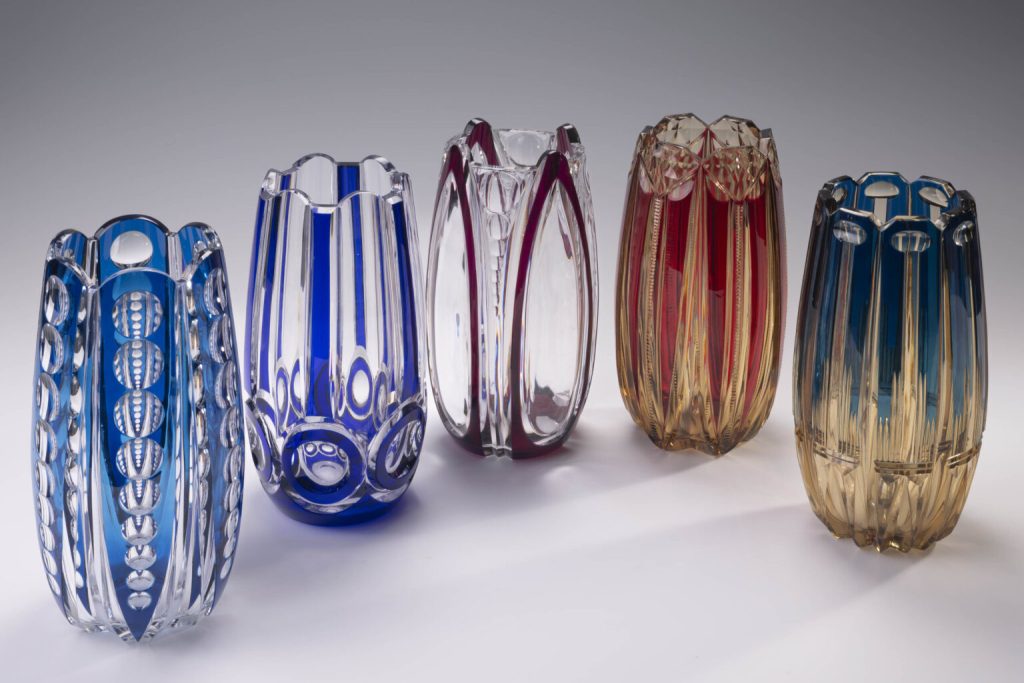
Then came the interwar years, arguably Val Saint-Lambert’s most dazzling period. The factory switched to Art Deco and early modernism: cleaner geometry, bolder forms, crystal as an architectural material rather than mere decoration. Those who could afford them couldn’t get enough of Val Saint-Lambert Crystal glasses, vases, and decanters designed in the 1920s and 30s. But hard times were just around the corner.
Decline, resistance, and survival
During the Wall Street Crash of 1929, luxury markets evaporated almost overnight. Then came the Second World War, during which the factory was bombed (by both sides!). When peace returned, so did the will to rebuild, but the world had changed.
The decades that followed were marked by struggle. In 1971, the Belgian state took control. Four years later, in 1975, workers occupied the factory for six months, refusing to accept closure. Their determination bought time, but it could not hold back the tide.
From 1987, the factory passed through a succession of private owners, with bankruptcies and painful layoffs following one another. By the time entrepreneur George Arthur Forrest took a 75% stake in 2018, Val Saint-Lambert had shrunk dramatically. Today, around fifteen people work on the factory floor. Production continues, but in small, carefully crafted series.
Celebrating 200 years of Val Saint-Lambert Crystal
To celebrate the bicentenary year (and the famous past) of Val Saint-Lambert Crystal, from April to December 2026 a series of exhibitions and events have been planned. Here’s my personal pick of four of the best:
- Cristal Vivant (Living Crystal) at the Val Saint-Lambert Museum in Seraing is open from 11 April to 6 December 2026. It traces the full arc of the factory’s history, from its monastic origins to the present day. Visitors can watch glass-blowing demonstrations by master craftsmen, wander through a selection of iconic historical pieces, and experience an immersive 360° installation in the monks’ former dormitory. Until 21 June, there are also evening shows combining live performers, music, and projections on the old abbey façade.
- Beyond Seraing, at the Museum of Fine Arts in Charleroi, the exhibition Art Déco and Modernism at Val Saint-Lambert (1925-1939) runs from 18 April to 27 September. It explores how the factory embraced the clean geometry of the interwar years.
- The Grand Curtius Museum in Liège is hosting Japonism and Art Nouveau from 17 April to 27 September, with around 150 works tracing the Belle Époque golden age.
- The Design Museum Brussels is devoting its major spring exhibition, Val Saint-Lambert & Design (1958-2000), running 24 April to 25 October, to the factory’s reinvention during the second half of the twentieth century.
I hope that you are able to get to at least one of these exhibitions. If so, I would be interested to hear your feedback.

I created Discovering Belgium in 2011 to share the country’s hidden stories, fascinating places, and remarkable people. Through articles, photography, and audio walks, I share discoveries that reveal Belgium beyond the obvious. Hope you enjoy this site.
How sad that it declined so. That vase is amazing, would love to see that.
Yes it’s certainly impressive. Wonder how much it’s insured for, and who has to clean it.
What exquisite work! Success until the end of time is never guaranteed.